
Rezoning Wrap Up
Examining the Entrails of Calgary's Housing Strategy

What Happened?
The hearings are done, the votes counted, and the press conferences held. Where are we now?
Council down-zoned Calgary by a vote of 12-3
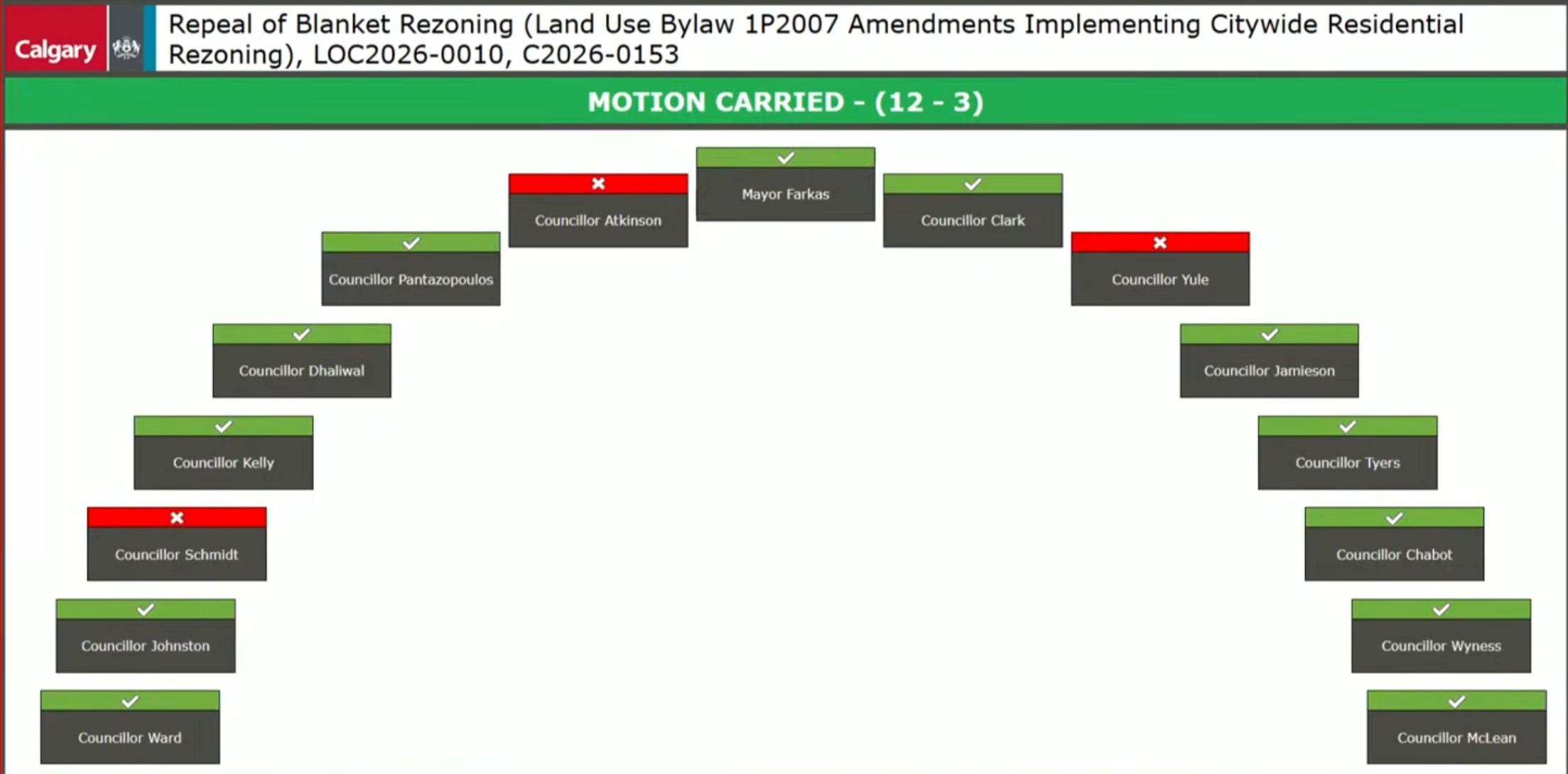
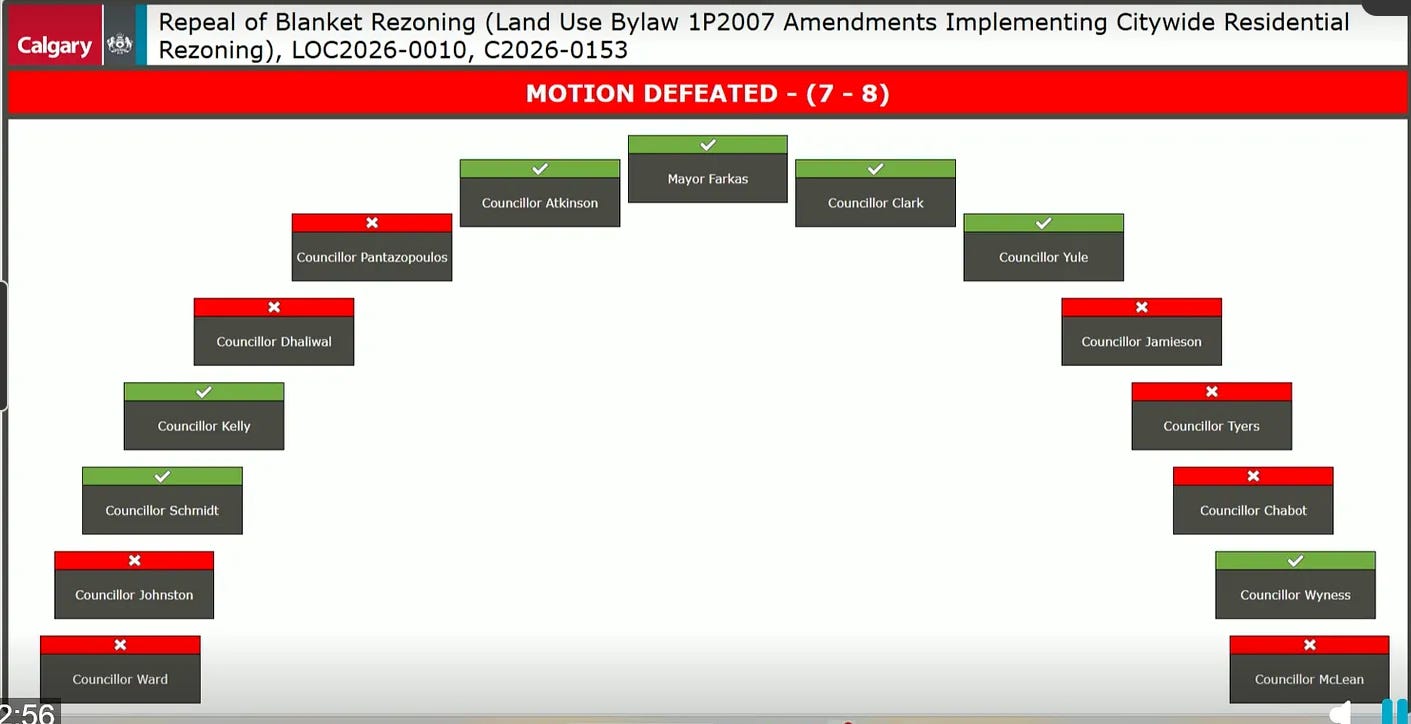
Councillors even voted against allowing basement and garage suites on the same lot…
Calgary was blanket down-zoned and council failed to pass a replacement plan. This was despite 156 public hearing speakers urging council to retain rezoning and dozens more arguing for a real replacement plan. This decision will increase the cost of housing in Calgary, jeopardize over 800 million dollars in federal funding for housing and transit, and is driving construction business out of Calgary to neighbouring cities like Airdrie and Cochrane. The Inner City Builders Association and development consulting firms were clear with Council: business is already leaving Calgary because of this decision.
When considering amendments, Council refused, by a vote of 8-7, an attempt to allow backyard suites and basement suites as a form of gentle density and, by an 11-4 vote, they revoked permission for townhouses along zoned neighbourhood corridors in existing Local Area Plans (LAPs) that had received community approval. The disappearance of a moderate middle ground, with Jennifer Wyness, Raj Dhaliwal, Jeromy Farkas, John Pantazopolous, and Harrison Clark all voting to kill very modest H-GO corridors in wards 7 and 8, is an alarming signal as to how this Council values and will vote on housing.
The R-CG zone itself, the zone which is designed for missing middle row-houses, was made worse by the council. They reduced the allowable lot coverage area and reduced allowed building height. Council narrowly voted against completely killing the district by limiting it to 3, instead of 4 row-houses; although this may be a brief reprieve with Councillors discussing future motions to further gut the zone.
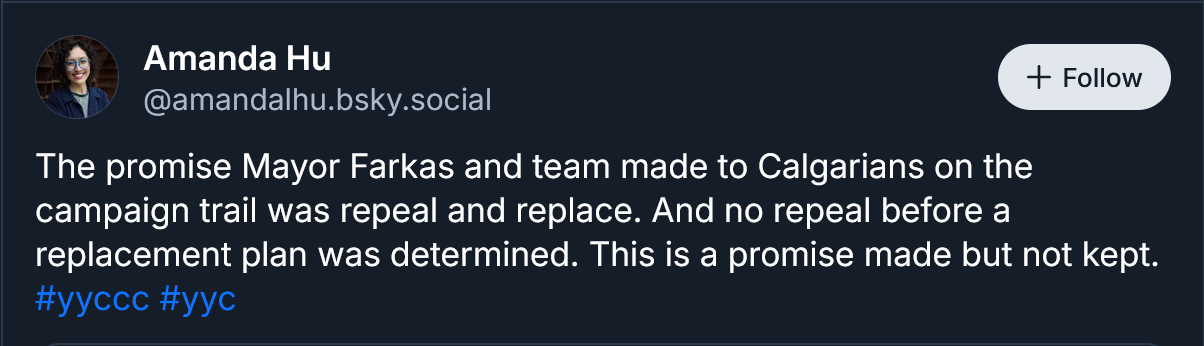
Mayor Farkas’ own campaign staffers are saying that this is a broken promise and Councillors that claimed they are supportive of thoughtful density and growth have revealed their actual preferences: a system of preferred access for connected suburban developers and combined with ongoing tax base decline and passing costs onto our children.
The Coalition and the Press Conference
Immediately following the decision, two dozen organizers and housing advocates convened a meeting to discuss what happened and what to do next. The first order of business was to host a press conference demanding that Mayor Farkas honour his campaign promise to replace rezoning. A commitment which his own staff believe he has broken. See Amandu Hu’s, former Farkas advisor, comments here.
Speakers and spokespeople from 11 community organizations, representing tens of thousands of Calgarians, attended along with members of the community. Willem Klumpenhouwer, Alice Lam, Julia Law, and Kersi Bird addressed the media, answered questions, and called on Mayor Farkas to fulfill his campaign promise and deliver a real replacement.
Media and Other Coverage
Global news
CTV news and more CTV news
CBC news
A full CBC radio show
CBC Homestretch interview with Kersi Bird
Denys, Alex, and Dominick on Council Island
The Herald also covered the press conference on the front page of the paper edition. Scott Strasser’s digital herald article can be found here
Farkas’ Counter Scrum
Following our press conference, Jeromy Farkas held a counter scrum with reporters about an hour after our press conference.
Farkas stated that he is opposed to a blanket replacement and says that some blanket zoning supporters just want a new blanket option. He claimed that he is having good conversations with the Federal Government on retaining HAF funding. Farkas claimed that this council is committed to fast and major action on infrastructure and housing citing funding for affordable housing, accelerated LAPs, and funding for the chief housing officer. He argued that nodes and corridors are the solution and that trickle down housing doesn’t work.
Farkas’ counter arguments are not credible when you look at the facts. Despite claiming nodes and corridors are the solution, council voted 11-4 against H-GO corridors in already LAP approved areas in ward 7 and 8. While claiming that affordable housing funding is important, the Mayor and council are risking millions of dollars for affordable housing by making Calgary non-compliant with the HAF agreement. As for the claim that accelerated LAPs will solve the problem, that’s just more money for bureaucracy and a method that the council is showing us won’t work. LAPs don’t lead to rezoning and council has shown it will vote down many rezoning applications that are fully LAP compliant.
Farkas’ comments are inconsistent with the policy evidence on housing. The Globe and Mail Editorial Board summed it up here.
“This is an imperfect solution that will lead to slower development than letting the free market work. Unfortunately, this approach will reduce the number of options for Calgarians looking to buy a place to live – and fewer homes mean higher prices. That’s just economics.“ - Globe Editorial Board
Commentary and Policy
Calgary City Council made a serious mistake. We aren’t just losing housing; we are exporting our tax base and our skilled labour to cities that actually want to grow.
Council can address these problems, if they have the political will. A few options going forward include:
1. Moving towards an outcome based zoning framework instead of a prescriptive one. This is a topic I will likely write more on.
2. Expanding options for duplexes and suites; the first step for which will come on July 21st when council considers making garage suites and basement suites permitted uses in all of the residential zones.
3. Delivering transit oriented development. The down-zoning removed R-CG zoning around C-Train stations.
4. Delivering specific housing projects. When will there be housing on the vacant lot by Westbrook C-Train station? There are many good projects that could be built if this Council does their part in making them happen.
There were two pieces of good news from the hearing. First, the repeal makes row-houses a permitted use in R-CG, thus despite making the zone worse, council did make it easier for developers to avoid appeals once they actually get a zoning change through council. More power for council and less power for neighbourhoods wasn’t quite the stated goal of this process, but there you have it. Second, council voted 10-5 to bring secondary suites as a permitted use to the July public hearing. This could be a good first step in expanding the use of garage suites as a form of gentle density, but it will have to be paired with less restrictive and prescriptive rules for actually building garage suites.
What is Next?
I don’t think that this is over. Mayor Farkas will face serious political pressure as the consequences of his actions become apparent to Calgarians.
This council term will need a full court press from Calgarians across the city who want to build housing.
This was a tough few weeks for the pro-housing movement in Calgary. What we do next could shape the future of our city for decades.
Come learn more, discuss housing policy, and meet other housing enthusiasts at:
What’s Next for the Neighbourhood? - Wednesday May 6, 6-8 PM in the Patricia Whelan Auditorium and the Central Library: https://luma.com/orfaa5k2?tk=hOPxDq
I’m always happy to chat. Shoot me a DM and we can grab coffee.